


Discover how does sound travel through air, water, and solids. Learn sound waves, speed, examples, myths, and fascinating facts.
Sound is everywhere. You hear it when someone speaks, when birds sing outside your window, and when your favorite song plays through a speaker. Yet many people never stop to think about how does sound travel from one place to another.
Unlike light, sound cannot move through empty space. It needs particles to carry its energy. Whether sound travels through air, water, or solid materials, it always begins with a vibration.
In this guide, you’ll learn exactly how sound travels, what affects its speed, why sound behaves differently in various materials, and some fascinating facts that most articles never mention.
What Is Sound?

Sound is a form of energy produced by vibrations.
When an object vibrates, it causes nearby particles to move. These moving particles pass energy to neighboring particles, creating sound waves that travel through a medium.
Common sources of sound include:
- Human voices
- Musical instruments
- Speakers
- Thunder
- Engines
- Animals
Every sound you hear starts with a vibration.
How Does Sound Travel?
Sound travels as a mechanical wave through a medium.
A medium can be:
- Air
- Water
- Wood
- Metal
- Glass
When an object vibrates, it creates areas of high and low pressure around it. These pressure changes move outward as sound waves.
The Step-by-Step Journey of Sound
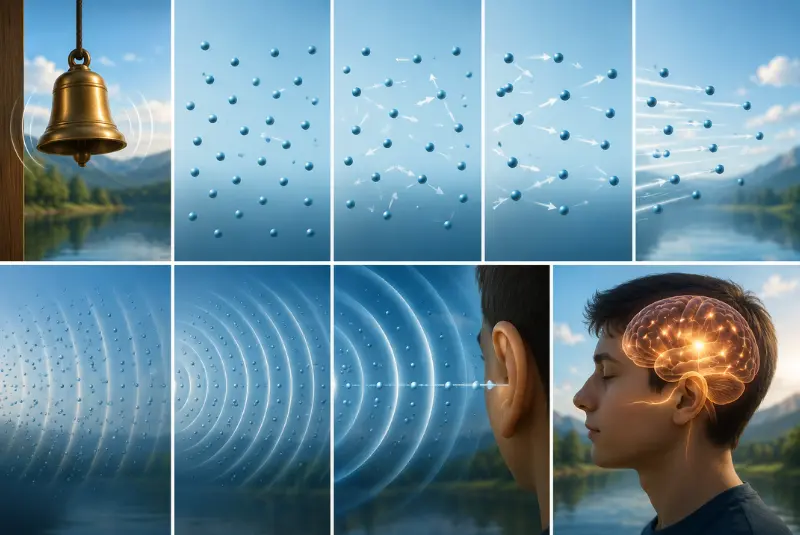
An object vibrates.
- Nearby particles begin moving.
- These particles collide with neighboring particles.
- Energy transfers from particle to particle.
- Sound waves spread outward.
- The waves reach your ears.
- Your brain interprets the signals as sound.
Think of dropping a pebble into a pond. Ripples spread outward from the point of impact. Sound waves behave similarly, except they move through particles instead of water surfaces.
Why Does Sound Need a Medium?
One of the most important facts about sound is that it requires a medium to travel.
A medium contains particles that can transfer energy.
Without particles, sound has no way to move.
Examples of media include:
- Air
- Water
- Steel
- Wood
- Glass
This is why sound behaves differently in different environments.
Can Sound Travel Through Space?
No.
Outer space is nearly a vacuum, meaning it contains very few particles.
Since sound requires particles to carry vibrations, sound cannot travel through space.
This is why astronauts cannot hear explosions occurring far away in space.
How Does Sound Travel Through Air?
Air is the medium humans experience most often.
When you speak, your vocal cords vibrate and create pressure changes in the surrounding air.
These pressure changes move outward as sound waves until they reach another person’s ears.
Speed of Sound in Air
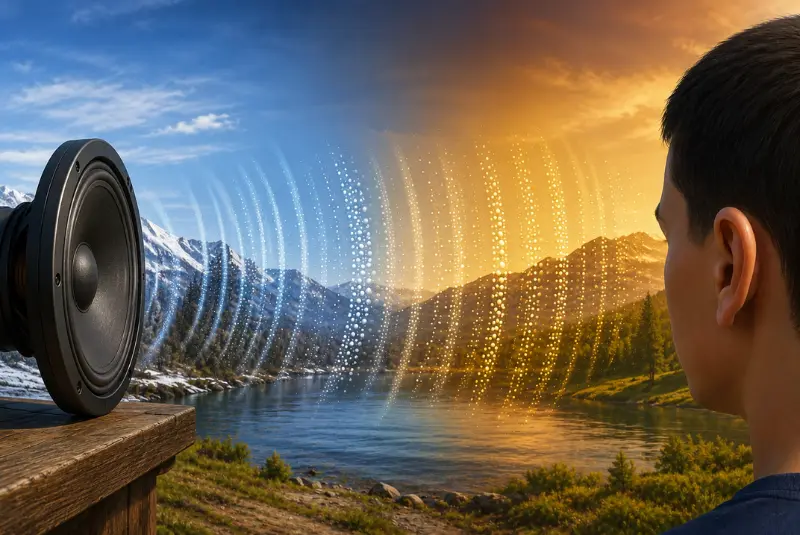
At room temperature, sound travels at approximately:
- 343 meters per second
- 1,125 feet per second
- 767 miles per hour
Warmer air allows sound to travel slightly faster because particles move more rapidly.
How Does Sound Travel Through Water?
Water carries sound much more efficiently than air.
Because water particles are closer together, vibrations transfer energy more quickly.
Speed of Sound in Water
Sound travels at approximately:
1,480 meters per second
This is more than four times faster than sound travels through air.
Whales, dolphins, and submarines rely on sound because it travels exceptionally well underwater.
How Does Sound Travel Through Solids?
Sound travels fastest through solids.
In solids, particles are tightly packed together, allowing energy to move rapidly.
Speed of Sound in Common Solids
| Material | Speed of Sound |
| Wood | 3,300 m/s |
| Glass | 4,500 m/s |
| Steel | 5,960 m/s |
This explains why you can hear vibrations through walls, floors, and railway tracks.
Which Medium Carries Sound the Best?
The speed of sound depends on particle arrangement.
| Medium | Approximate Speed |
| Air | 343 m/s |
| Water | 1,480 m/s |
| Wood | 3,300 m/s |
| Glass | 4,500 m/s |
| Steel | 5,960 m/s |
Generally:
- Solids transmit sound fastest.
- Liquids transmit sound faster than gases.
- Gases are the slowest medium.
Factors That Affect How Sound Travels
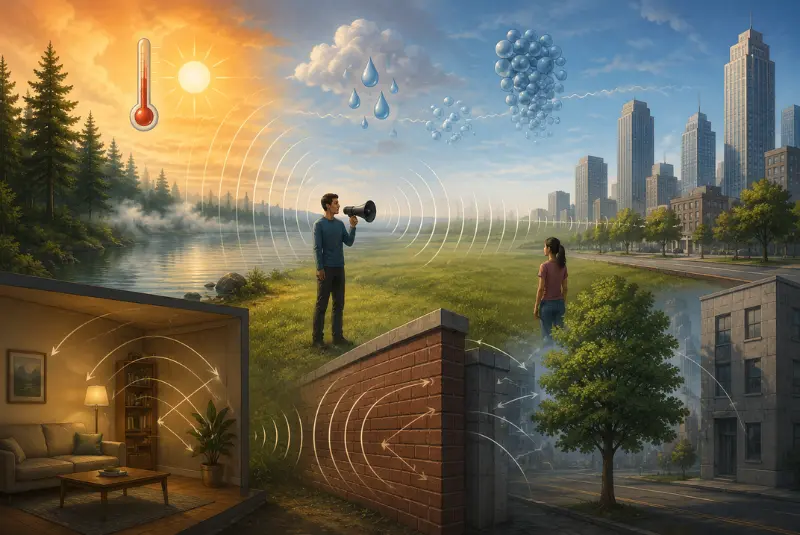
Several factors influence sound propagation.
Temperature
Higher temperatures increase sound speed.
Humidity
Moist air can slightly improve sound transmission.
Density
Denser materials often allow faster sound travel.
Distance
Sound becomes weaker as it moves farther from its source.
Obstacles
Walls, furniture, trees, and buildings can absorb or reflect sound waves.
Types of Sound Waves
Humans cannot hear every sound frequency.
Audible Sound
Humans hear frequencies between:
- 20 Hz
- 20,000 Hz
Infrasound
Frequencies below 20 Hz.
Examples:
- Earthquakes
- Volcanic activity
- Elephant communication
Ultrasound
Frequencies above 20,000 Hz.
Examples:
- Medical imaging
- Bat navigation
- Industrial testing
How Humans Hear Sound
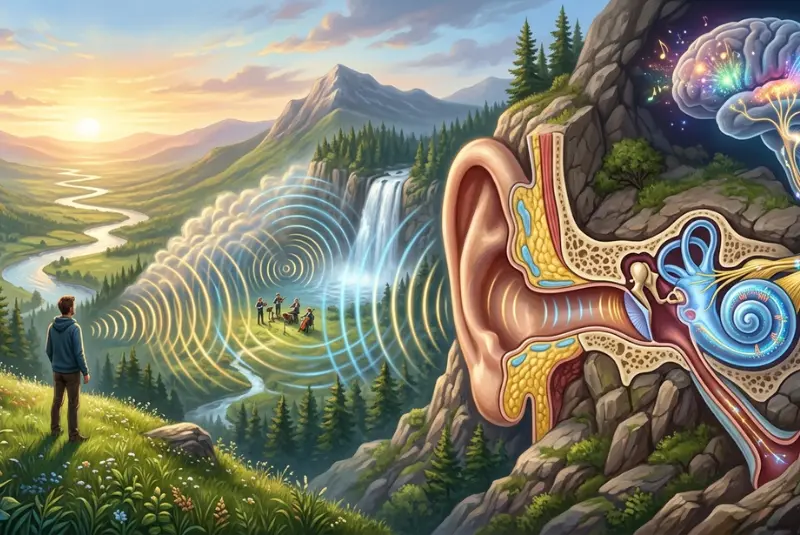
Hearing is a remarkable process.
Sound’s Journey Through the Ear
- Sound waves enter the outer ear.
- The eardrum vibrates.
- Tiny bones amplify vibrations.
- Vibrations enter the cochlea.
- Hair cells convert vibrations into electrical signals.
- The brain interprets those signals as sound.
Without this process, sound waves would have no meaning to us.
Sound Reflection, Absorption, and Diffraction
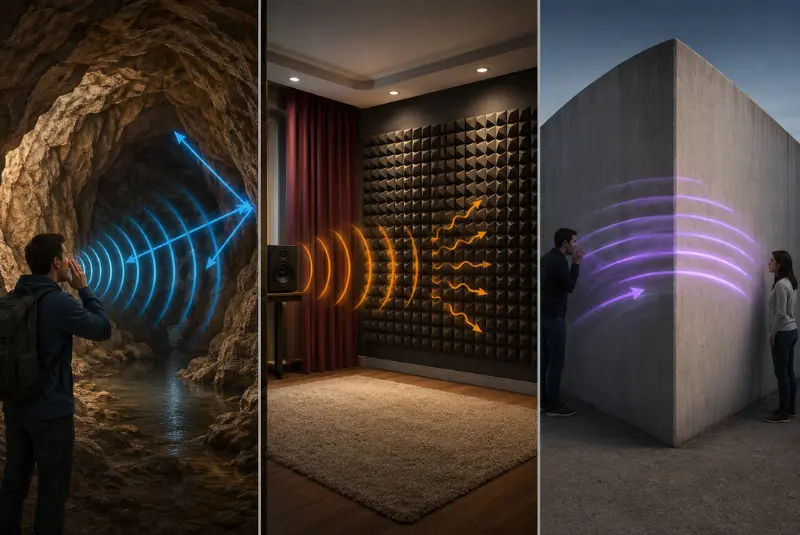
Most articles explain sound travel but ignore how sound behaves after hitting objects.
Reflection
Sound bounces off hard surfaces.
Examples:
- Echoes in caves
- Empty hallways
- Large auditoriums
Absorption
Soft materials absorb sound energy.
Examples:
- Curtains
- Carpets
- Acoustic foam
Diffraction
Sound bends around obstacles.
This is why you can hear someone speaking around a corner even when you cannot see them.
How Animals Use Sound
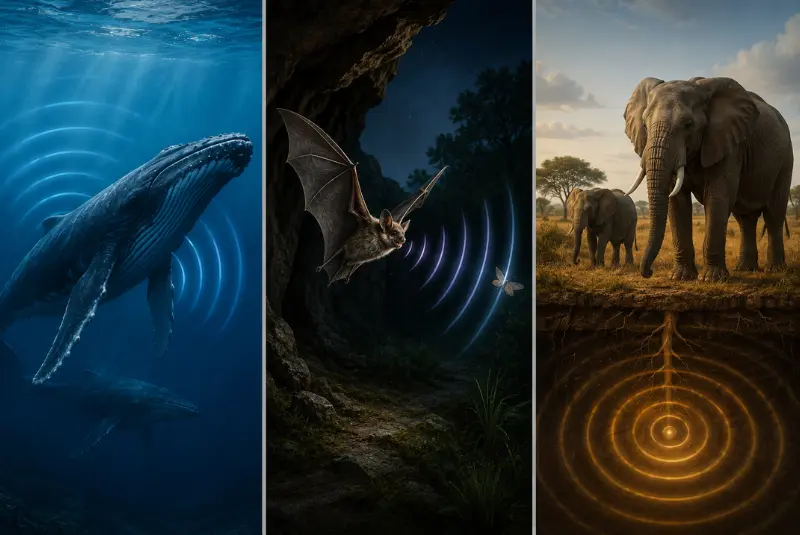
Animals often use sound in ways humans cannot.
Whales
Whales use low-frequency sounds that travel hundreds of miles underwater.
Bats
Bats use echolocation to navigate and hunt.
Elephants
Elephants communicate using infrasound that travels several miles through the ground and air.
Real-World Applications of Sound

Understanding sound helps improve modern technology.
Examples include:
- Sonar systems
- Medical ultrasound
- Noise-canceling headphones
- Hearing aids
- Architectural acoustics
- Underwater communication
These technologies depend on understanding how sound waves move through different materials.
Fascinating Facts About Sound Travel
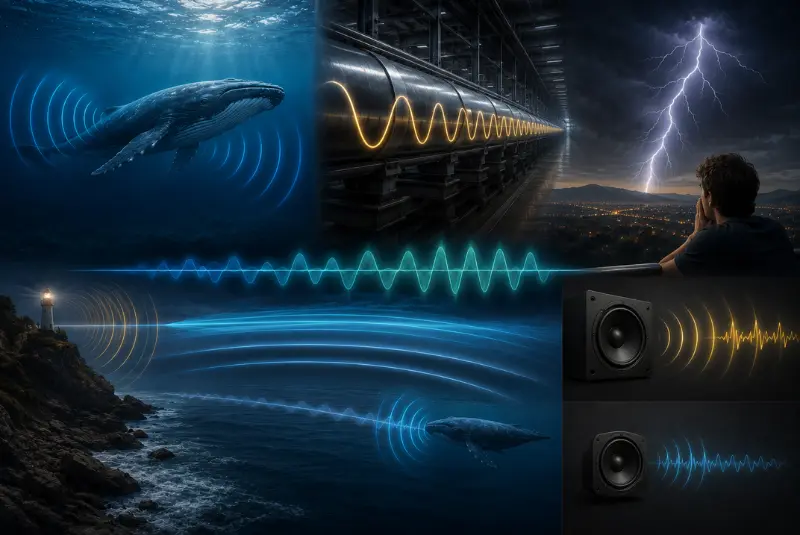
Many people do not know these surprising facts:
- Sound travels faster underwater than in air.
- Sound travels fastest through steel.
- You can see lightning before hearing thunder because light travels much faster than sound.
- Whales can communicate across vast ocean distances.
- Some sounds can travel thousands of miles through special ocean layers.
- Loud sounds do not travel faster than quiet sounds.
Common Myths About Sound
Sound Travels Through Space
False.
Sound needs a medium.
Loud Sounds Travel Faster
False.
The medium determines speed, not loudness.
Sound Always Travels in Straight Lines
False.
Sound can bend around obstacles through diffraction.
Simple Sound Experiments You Can Try
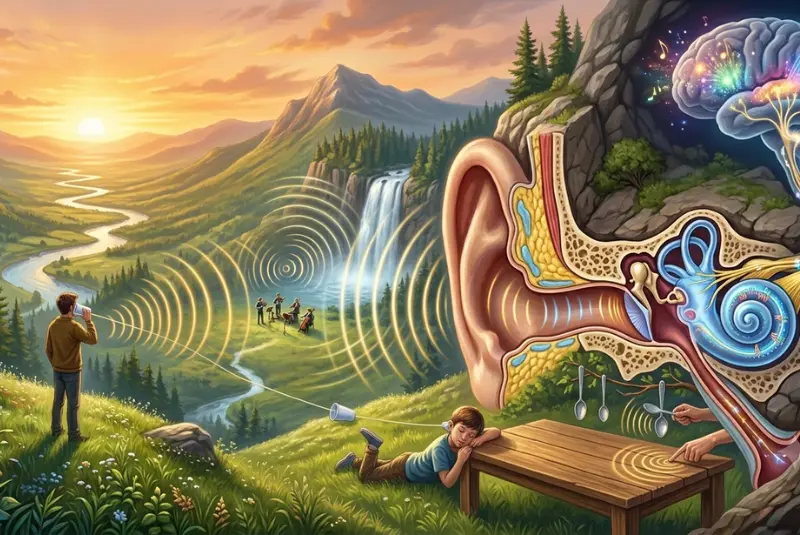
Cup-and-String Telephone
Use two cups connected by a string to observe sound transmission.
Spoon and String Experiment
Tap a metal spoon attached to a string and listen to how vibrations travel.
Knock on a Table
Place your ear on a table and tap it lightly to hear how sound travels through solids.
FAQS
How does sound travel from one place to another?
Sound travels as vibrations that move through a medium such as air, water, or solids. The vibrations pass from particle to particle until they reach a listener.
Can sound travel through space?
No. Sound cannot travel through space because space is mostly a vacuum and lacks the particles needed to carry sound waves.
Why does sound need a medium to travel?
Sound is a mechanical wave that depends on vibrating particles to transfer energy. Without a medium, sound cannot move.
Does sound travel faster in water or air?
Sound travels much faster in water than in air because water particles are closer together, allowing vibrations to transfer more efficiently.
Which medium carries sound the fastest?
Sound travels fastest through solids because their particles are tightly packed, making energy transfer quicker than in liquids or gases.
What affects the speed of sound?
Several factors affect sound speed, including the medium, temperature, density, humidity, and pressure of the environment.
Why do we see lightning before hearing thunder?
Light travels much faster than sound. As a result, lightning reaches your eyes almost instantly, while thunder takes longer to reach your ears.
Can sound bend around objects?
Yes. This phenomenon is called diffraction. It allows sound waves to bend around obstacles and reach areas that are not in a direct line of sight.
How do animals use sound differently than humans?
Many animals can hear frequencies outside the human hearing range. For example, bats use ultrasound for echolocation, while elephants use infrasound to communicate over long distances.
What are some everyday examples of sound travel?
Common examples include hearing someone speak, listening to music through speakers, hearing a doorbell ring, listening to birds sing, and hearing thunder during a storm.
Final Thoughts
Sound is an essential part of everyday life, yet many people never consider the science behind it. Understanding how does sound travel helps explain everything from simple conversations to advanced technologies like sonar and ultrasound.
Sound begins with a vibration and moves through a medium such as air, water, or solids. Because particles in different materials are arranged differently, sound travels at different speeds depending on the medium. It moves fastest through solids, slower through liquids, and slowest through gases. Unlike light, sound cannot travel through the vacuum of space because there are no particles available to carry its energy.
Whether you’re listening to music, hearing thunder after lightning, or communicating with someone across a room, sound waves are constantly at work. By learning how sound travels, we gain a deeper appreciation for the invisible forces that help us experience and interact with the world around us every day.
