


For most travelers, yes. The train connects both RER B from CDG to Paris terminals to central Paris in 25 to 50 minutes for around 13 to 14 euros, running from roughly 4:50 a.m. to 11:50 p.m. It beats a taxi on price and beats a bus on speed, but it is not automatically the right call if you land late, carry heavy bags, or arrive during one of the RER’s periodic strikes.
What Nobody Tells You Before You Board
Every guide to this route repeats the same basics: two stations, one line, a ticket machine. What they skip is the stuff that actually trips people up on the ground.
The RER B splits into an express and a local pattern, and the overhead screens do not always make that obvious to a jet-lagged first-timer. An express train from CDG can reach Gare du Nord in about 25 minutes, skipping most stops. A local train making all nine stops can take closer to 50 minutes. Both trains say “Paris” on the front. Neither is labeled “express” in plain English on the platform sign, only on the departure board as a stop count.
My take: I always check the digital board for the number of intermediate stops listed under the departure time, not just the destination name. Fewer dots on that display means a faster ride, even if two trains are heading to the exact same place five minutes apart.
The Terminal 1 Trap

If you land at Terminal 1, you cannot walk straight to a train platform. You need the free CDGVAL shuttle to Terminal 3 (Roissypole), where the actual RER B station sits. This adds 10 to 15 minutes that most trip planners never factor into their “25-minute train” claim. Terminal 2 arrivals have it easier since their station sits right between terminals 2C and 2E.
Budget an extra 15 minutes if you land at Terminal 1. It is a small detail that changes whether you make a tight connection.
What a Ticket Actually Costs, and Where People Overpay
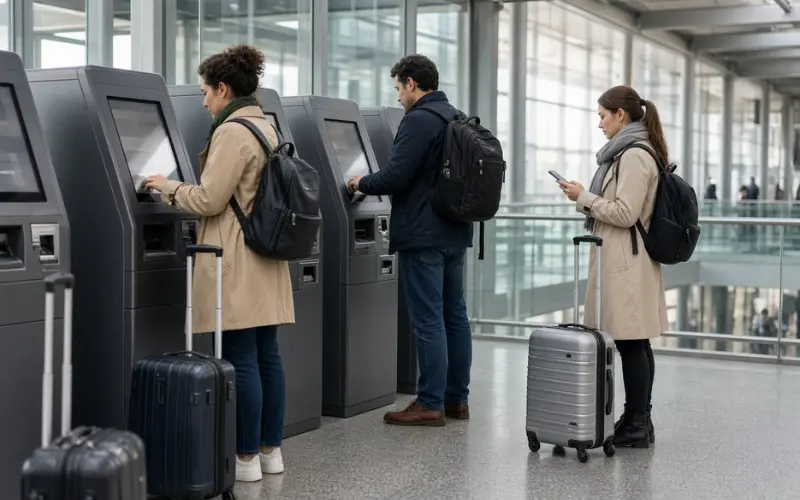
The single adult fare runs about 13 to 14 euros as of early 2026, with a small surcharge if you need a physical Navigo Easy card versus loading the ticket on your phone. Kids aged 4 to 9 typically travel around half price, and children under 4 ride free.
Here is the part competitors gloss over: buying online in advance sometimes costs more, not less, once booking fees are added. Walk-up ticket machines and staffed counters at both CDG stations are reliable and multilingual, so pre-booking mainly buys peace of mind, not savings.
| Transfer option | Typical cost (one way) | Typical time to center |
|---|---|---|
| RER B train | €13 to €14 | 25 to 50 minutes |
| Roissybus | €17 to €18 | 60 to 70 minutes |
| Local bus (350/351) | From €2 | 70 to 90 minutes |
| Taxi (flat rate) | €55 to €62 | 45 to 60 minutes, traffic dependent |
This is the trade-off the article’s title is really asking about. The RER B from CDG to Paris wins on cost every time. It only loses to a taxi when you are traveling with three or more people splitting the fare, or when your flight lands after midnight and the trains have stopped running.
The Strike Question Nobody Wants to Ask
French rail strikes are not rare, and RATP and SNCF staff who run the RER B from CDG to Paris are covered by the same labor calendar as the rest of the network. Before you fly, a quick search for “grève RER B” plus your travel date, or checking the RATP app directly, tells you whether service will run on a reduced schedule. During a strike, frequency can drop to one train every 20 to 30 minutes instead of the usual 6 to 15, and trains get noticeably more crowded. This single check has saved me from standing on a packed platform more than once.
Luggage, Theft, and the Reality of a Crowded Train
The RER B from CDG to Paris has a reputation, deserved, for pickpocketing, especially on the Gare du Nord approach where the platform gets dense with commuters and tourists at the same time. Keep bags in front of you, not on your back, once the train fills up. Overhead luggage racks exist but are shallow and better suited to backpacks than large suitcases. If you are traveling with two full-size checked bags, know that you will likely need to stand near your luggage rather than store it out of reach, since the aisles narrow fast during peak hours.
Choosing Your Exit Station Based on Your Hotel
Most guides list the stations. Fewer explain how to choose one RER B from CDG to Paris.
- Gare du Nord: best if your hotel sits near Montmartre or Sacré-Coeur, and the natural transfer point for Eurostar connections.
- Châtelet-Les Halles: the most connected stop, with four metro lines and three RER lines, ideal if your hotel is near the Louvre or Marais.
- Saint-Michel-Notre-Dame: puts you on the Left Bank, walkable to the Latin Quarter and Notre-Dame.
- Luxembourg: closest option for hotels near the Jardin du Luxembourg or the 5th arrondissement.
If your hotel is nowhere near these five stops, plan on one metro transfer after you exit, which the RER B ticket usually covers within the same journey if you keep moving through connected gates without exiting to the street.
When the RER B Is Not Your Best Move
If your flight lands after 11:50 p.m., the last train has already gone and your realistic options are a taxi, a pre-booked private transfer, or an overnight wait. Same logic applies to flights departing before 5 a.m. Families juggling strollers and car seats often find the taxi’s door-to-door simplicity worth the extra cost too, since the RER B stations involve stairs and distance walking that a stroller makes slower and more stressful.RER B from CDG to Paris.
For a sense of how this compares to other major airport rail links, the RER B stacks up well against Newark’s AirTrain to Manhattan connection and the JFK AirTrain to subway route into Manhattan, both of which share the same basic trade-off between cost and convenience. If you are hopping onward to Italy after Paris, the setup is similar to Rome’s Fiumicino to Termini train, and travelers heading to Spain next will recognize the same pattern on the Barcelona airport Aerobus route.
FAQ on RER B from CDG to Paris
Is the RER B the fastest way from CDG to Paris?
It is usually the fastest public transport option, though a taxi can be faster outside rush hour with no train changes needed.
Can I use my phone to buy an RER B ticket?
Yes, tickets can be loaded through official transit apps or Apple Wallet, which also avoids the small physical card surcharge.
How early should I arrive for the RER B before a flight?
Aim to be at the CDG train station at least 90 minutes before a European flight and closer to 3 hours before an intercontinental one, accounting for security lines after the train ride.
Does the RER B run on Christmas or New Year’s Day?
Yes, the schedule runs daily including holidays, though frequency can drop slightly.
Is there a direct RER B connection to Disneyland Paris?
No, the RER B does not go to Disneyland. That connection runs on a separate RER A line or TGV service from CDG.
What happens if I board the wrong RER B train?
The line splits south of Paris toward different suburban branches, so double-check the final destination shown on the train itself, not just the platform sign, before boarding.
Are there luggage restrictions on the RER B?
No official limit exists, but space is tight, so oversized bags are easier to manage outside peak commuter hours.
Can I use a Paris Visite pass on the RER B from CDG?
Yes, as long as it covers zones 1 through 5, which include the airport.
