

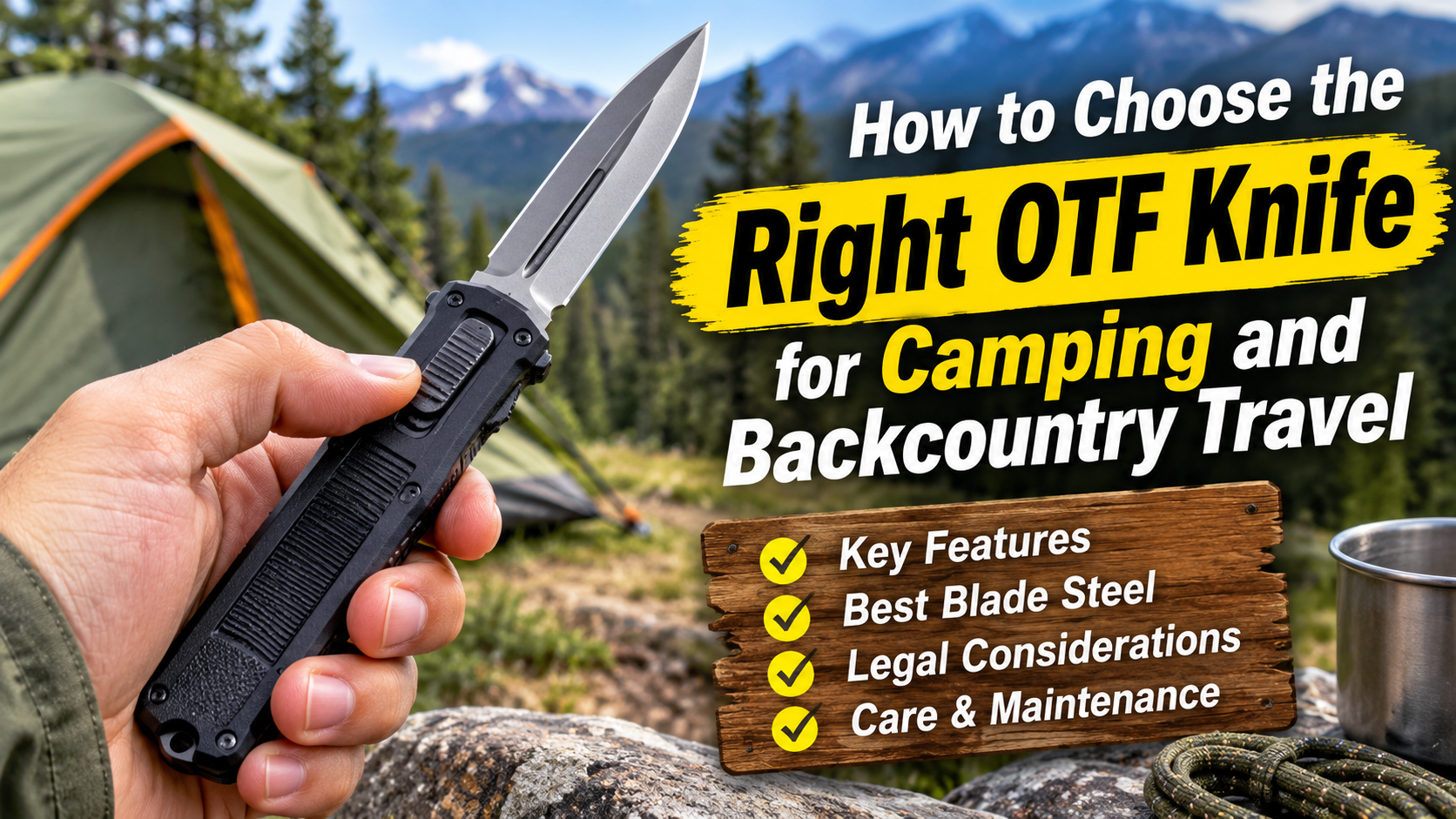
An out-the-front knife, usually called an OTF knife, fires its blade straight out of the handle with a slide of the thumb and pulls it back the same way. For campers and backcountry travellers, that one-handed action is the main attraction: you can open it while holding a rope, a torch, or a tent pole.
The right model also needs the right blade steel, a handle that stays secure in wet hands, and a mechanism that still works after a week of dust and damp. This guide explains what to look for in an automatic knife built for the outdoors, how a double-action OTF differs from other folders, what the laws say about carrying one, and when a custom OTF knife is worth the extra thought.
Key Takeaways
- An OTF knife is a fast, one-handed cutting tool for camp tasks, not a replacement for a fixed blade.
- Choose a double-action mechanism with a solid lock-up and no blade play.
- Pick blade steel by climate and trip length: 440C or D2 for casual use, S35VN or M390 for long, wet trips.
- A 3 to 3.5 inch drop-point or spear-point blade with a plain edge handles most outdoor work.
- Match handle material and texture to wet hands and gloves, and keep weight under 120 grams.
- A custom OTF knife makes sense when you want specific materials, dimensions, or branding.
- Always check knife laws for your destination and transit points, and fly with the knife in checked baggage.
What an OTF Knife Is and Why Campers Like It
Most pocket knives are folders. The blade pivots out from the side of the handle and locks in place. An OTF knife works differently. The blade sits inside the handle and travels forward in a straight line along an internal track when you push a slider. Push the slider back and the blade retracts.
The appeal for outdoor use comes down to three things:
- One-handed operation: You can deploy the blade without changing your grip or using your other hand, which matters when you are steadying a pot, holding a map, or managing a dog lead.
- Compact carry: The closed knife is a flat rectangle with no exposed blade edge, so it rides cleanly in a pocket or on a pack strap.
- Speed: When you need to cut a tangled line, open a food pouch, or slice through tape, the blade is ready instantly.
OTF knives started as tactical and military tools, and the design still carries that reputation. In practice, a well-built OTF is simply a fast, convenient utility knife, and a growing number of hikers and campers now carry one alongside a fixed blade.
What it is not good at
Honesty matters here. An OTF is not a bushcraft knife. The internal mechanism and the blade’s connection to the handle are not built for batoning firewood, prying, or heavy chopping. Treat it as a cutting tool for cordage, food, packaging, and light carving, and carry a fixed blade or a small hatchet for the heavy work.
Start With the Mechanism
Double-action versus single-action
A double-action OTF deploys and retracts the blade with the same slider. This is the most practical design for camp use, because every operation is a single thumb movement. Single-action models fire the blade automatically but need a separate manual pull to reset the spring and retract it. For travel, the double-action layout means fewer steps when your hands are cold, wet, or busy.
Look for a solid lock-up
A good OTF should have no blade wobble once deployed. Side-to-side play or a slight rattle usually means loose internal tolerances, and that only gets worse with use. Manufacturers that hand-tune spring tension and stress-test each unit before shipping produce knives that stay reliable after hundreds of cycles. Ask about this before buying, or check reviews that mention blade play after several months of use.
Understand the safety behaviour
Most double-action OTF knives include a feature where the blade disengages from the spring if it meets resistance during deployment. If the blade hits something on the way out, it stops rather than forcing through. You then push it forward by hand to reset. This is normal and a useful safety design, but it means the knife should never be fired against a surface.
Choose the Blade for the Job
Blade steel decides how long an edge lasts, how easily it sharpens in the field, and how it copes with moisture. The table below covers the steels most often used in OTF knives.
| Blade steel | Best for | Trade-off |
| D2 | Budget-friendly, hard use, good edge holding | Semi-stainless, needs oiling in damp conditions |
| 440C | General camping, easy sharpening, corrosion resistance | Loses its edge faster than premium steels |
| 154CM | Balanced all-round performance | Mid-range price |
| S35VN | Long trips, wet climates, long edge life | Higher price |
| M390 | Premium use, very long edge retention | Harder to sharpen with basic field tools |
For most camping and travel, a 3 to 3.5 inch blade covers food preparation, cordage, kindling shavings, and gear repair. Blade shape also matters:
- Drop point: The most versatile choice. A strong tip and a curved belly for slicing.
- Spear point: Symmetrical and good for controlled cuts, common on OTF designs.
- Tanto: Strong tip for piercing, less suited to food prep.
- Double-edged dagger: Looks striking but is less useful around a campsite and restricted in more places.
A plain edge is easier to sharpen on the trail than a serrated one. If you want serrations for rope or webbing, choose a partially serrated blade so you keep a plain section for clean cuts.
Handle, Weight, and Carry
Handle materials
Aluminium is the most common OTF handle material for good reason. It is light, resists corrosion, and machines precisely. Aviation-grade 6061-T6 aluminium is a step up in strength. Zinc alloy handles cost less and feel heavier, which some people prefer. Titanium is the premium option: strong, light, and resistant to almost everything, but priced accordingly.
Grip texture
Looks matter less than grip. A smooth handle becomes slippery with rain, sweat, or fish oil. Look for machined texture, inlays, or grooves that give your fingers something to hold. Carbon fibre-style inlays and skeletonised handles can also reduce weight.
Weight and pocket clip
A knife under 120 grams is light enough that you will not think about it, which is the whole point. Check that the pocket clip is tight and deep enough to keep the knife secure, and that the slider cannot fire accidentally when pressed against the inside of a pack. Some models include a safety lock on the slider, which is worth having for travel.
Think About Your Climate and Trip Length
Not every OTF suits every environment. Match the knife to where you are going.
| Trip type | What to prioritise |
| Weekend car camping | Any reliable double-action with 440C or D2 steel |
| Multi-day backpacking | Light aluminium handle, S35VN or similar stainless blade |
| Wet, coastal, or river trips | Stainless steel blade, sealed or easy-to-clean mechanism |
| Desert or dusty terrain | Simple internals, regular cleaning, avoid heavy lubrication that traps grit |
| Cold-weather trips | Large slider that works with gloves, stronger spring tension |
Dust is the main enemy of an OTF mechanism. Sand and fine grit in the track cause weak deployment and misfires. In dusty conditions, carry the knife inside a pocket rather than clipped outside, and blow out the mechanism at the end of each day.
When a Custom OTF Knife Makes Sense
Off-the-shelf models suit most people. But if you want a specific steel, a particular handle material, a blade length matched to the kind of trips you take, or your own branding for a club or shop, a custom OTF knife from a direct manufacturer lets you choose those details rather than compromise.
Direct factories that own their CNC machining and assembly lines can adjust materials to hit a target price. That means a small outdoor retailer can order a batch with a D2 blade and zinc handle for the budget shelf, and a premium run with M390 steel and a titanium chassis for collectors, from the same supplier. For individuals, the main advantage is control: you decide blade profile, edge type, handle texture, and colour, instead of accepting whatever a brand shipped this season.
A few questions to ask any custom manufacturer:
- Do they own the factory, or are they a trading company reselling someone else’s work?
- Is every knife hand-tuned and tested for misfires before shipping?
- What minimum order quantity applies, and can you order a small batch first?
- Which steels and handle materials are offered at which price points?
- Can they laser-engrave a logo or name on white-label models?
Check the Law Before You Travel
This is the step people skip, and it causes the most trouble. Automatic knives, including OTFs, are regulated differently across countries, US states, Canadian provinces, and even individual cities and national parks. Some places allow them outright, some restrict blade length, some allow ownership but not public carry, and some ban them entirely.
Before any trip:
- Check the rules for your destination and every place you will pass through.
- Confirm whether the park or reserve you are visiting has its own restrictions.
- When flying, pack the knife in checked luggage, never in a carry-on.
- Keep the knife stored and out of sight in towns, and carry it only where it is clearly permitted.
Butterfly knives, also called balisongs, face similar or stricter rules in many regions. If you are choosing between the two for travel, an OTF is often the simpler option legally, but always verify for your route.
Keeping an OTF Knife Working Outdoors
A little care keeps an OTF reliable for years. Most problems come from neglect rather than from the knife itself.
After each trip
- Blow out the mechanism with compressed air or a few sharp breaths to clear grit.
- Wipe the blade dry, especially after cutting food or working near salt water.
- Add a single drop of light oil to the blade track. Too much oil attracts dust.
- Check the pocket clip and handle screws for looseness.
On the trail
- Keep the knife in a pocket or pouch in sandy conditions.
- If the blade stops mid-deployment, do not force the slider. Push the blade forward by hand to reset it.
- Sharpen on a small pocket stone or ceramic rod. Stainless steels such as 440C and S35VN respond well to a few light passes.
A Short Real-World Example
A group of volunteer trail maintainers in a coastal park needed a knife for cutting cordage, opening supply bags, and trimming webbing while wearing gloves. Folding knives were awkward to open one-handed with gloves on, and fixed blades were too bulky for the work vest.
They settled on a double-action OTF with a 3.3 inch drop-point blade in S35VN steel and a textured aluminium handle, chosen for its corrosion resistance in salty air. The group ordered a small custom batch with their organisation’s name engraved on the handle. After one season, the main feedback was that the knives stayed sharp through months of rope cutting and that the one-handed action saved time on every task. The only maintenance issue was grit in the track after beach days, solved by a quick blow-out each evening.
Frequently Asked Questions
Is an OTF knife good for camping?
Yes, for light to medium tasks such as cutting rope, preparing food, opening packaging, and small repairs. For splitting wood or heavy chopping, carry a fixed blade or hatchet alongside it.
How do I keep an OTF knife working in dusty or wet conditions?
Keep it in a pocket rather than clipped outside the pack, blow out grit at the end of each day, wipe the blade dry, and add one drop of light oil to the track every few trips.
What blade length is best for travel?
Around 3 to 3.5 inches. It handles most camp jobs comfortably and stays within the blade-length limits set by many jurisdictions.
Can I fly with an OTF knife?
Only in checked luggage, and only if the knife is legal at both your departure point and your destination. Never carry one in cabin baggage.
Are OTF knives reliable, or do they misfire?
A well-made OTF from a manufacturer that tunes and tests each unit is very reliable. Misfires usually come from grit in the mechanism, worn springs on cheap models, or firing the blade against an object.
What is the difference between an OTF knife and a butterfly knife?
An OTF fires its blade straight out of the handle with a spring. A butterfly knife, or balisong, has two handles that rotate around the blade and is opened by hand. OTFs are faster to deploy one-handed; balisongs are popular for flipping and collecting but need two hands or practice to open.
