

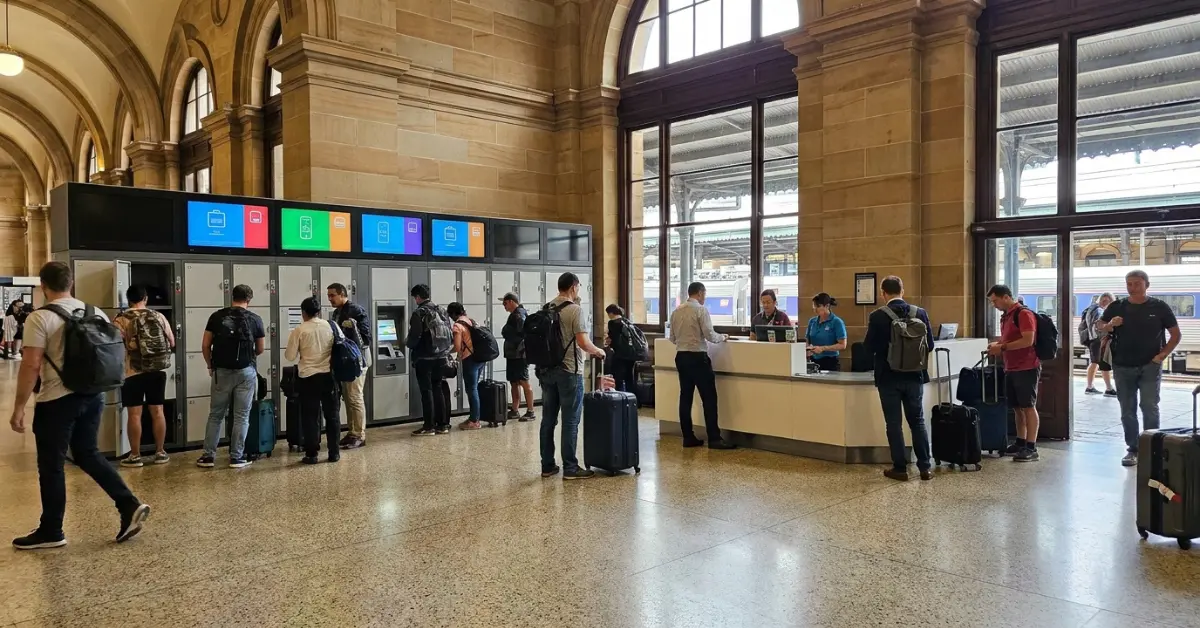
Is There Luggage Storage at Sydney Central Station? Yes, Sydney Central Station has an official luggage storage service, but it’s not the self-service coin lockers you’ll find at some European stations. It’s a staffed counter run by Smarte Carte, located in the Grand Concourse near Platform 1, and it operates on set daytime hours rather than 24/7. If you’re arriving outside those hours or the counter has a queue, third-party storage shops within a few minutes’ walk fill the gap.
That distinction matters more than most guides let on. A lot of pages online flatly say “no lockers at Central” or conflate the staffed counter with a wall of self-service boxes, and travelers show up expecting one thing and find another.
Where the Storage Counter Actually Sits
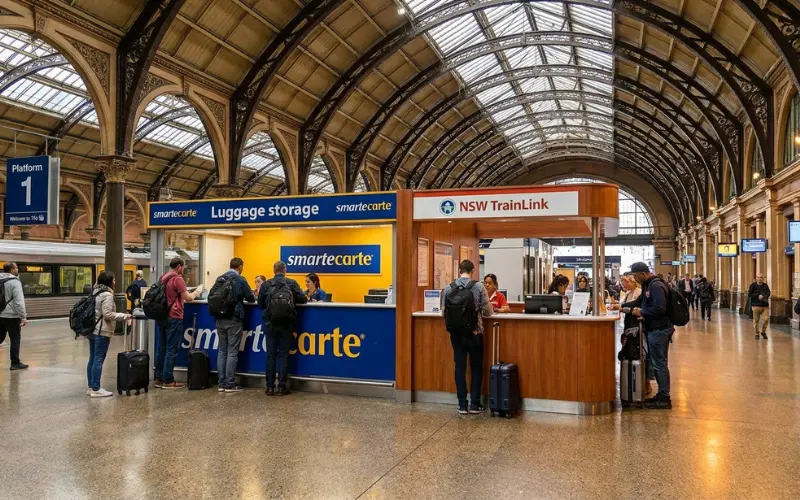
Central is a big station, easily Australia’s busiest, and the storage point is easy to miss if you don’t know the landmark.
- It’s in the Grand Concourse, the heritage main hall with the high arched ceiling, roughly opposite Platform 1.
- It sits close to the NSW TrainLink information point, so if you can find that desk, the storage counter is right nearby.
- Look for the Smarte Carte branding rather than a bank of lockers. It’s a manned counter where staff take your bag and hand you a claim ticket, closer to old-school left-luggage than a self-serve locker wall.
Because it’s staffed, hours are limited. Expect something in the range of early morning to mid-evening, not around-the-clock, so this isn’t the option for a 3 AM arrival or a midnight departure. Check current hours before you plan around it, since staffed counters at transit hubs do shift their timing without much notice.
Why “Are There Lockers?” Is the Wrong Question
Most search traffic on this topic assumes Central works like Berlin Hauptbahnhof or Paris Gare du Nord, where you badge a card and pull a locker door open yourself. Central doesn’t run that model.
Real-world nuance: because a person is physically handling the handover, you get a couple of things self-service lockers can’t offer, someone to flag if a bag looks suspicious or damaged, and a spot to ask a quick question about your onward platform while you’re there. What you lose is flexibility. If the counter’s closed, there’s no locker bank sitting empty for you to use instead. It’s staffed hours or nothing, in-station.
A separate free option regional travelers miss: if you’re booked on an NSW TrainLink regional or intercity service, you can often check your bag in early on the morning of travel at no cost, ahead of a later departure that day. This isn’t the same as the paid storage counter and it’s not available to same-day walk-ins without a ticket, but if you already have an NSW TrainLink booking, it’s worth asking about before you pay for storage elsewhere.
What Happens When the Counter Is Closed or Busy
Central handles well over a hundred thousand passengers a day, and the storage counter is one small operation inside that. Queues build fast around peak commuter hours and when regional services arrive in clusters.
If you hit a queue or arrive before opening:
- Third-party storage shops near the station, several within a five to ten minute walk toward Chalmers Street or Haymarket, run on app-based bookings with all-day or 24/7 access depending on the operator.
- These aren’t lockers either, they’re partner shops, cafes, or dedicated storage points where staff log your bag in and hand it back against your booking code.
- Pricing runs roughly A$3 to A$8 per bag per day depending on the provider, usually with a modest insurance guarantee built in, well below what you’d lose replacing gear if something went wrong.
In-Station Counter vs. Nearby Third-Party Storage
| Factor | Grand Concourse Counter (Smarte Carte) | Third-Party Storage Near Station |
|---|---|---|
| Access | Staffed daytime hours only | Often 24/7 depending on partner |
| Location | Inside the station, Grand Concourse | Short walk away, Chalmers St/Haymarket area |
| Booking | Walk-up, no advance booking needed | Usually booked via app in advance |
| Best for | Same-day travelers already at the station | Early arrivals, late departures, overnight storage |
Practical Edge Cases Worth Knowing
Flying in or out at odd hours:
Central itself is staffed and open 24 hours as a station, but that’s not the same as the storage counter being open. If your flight lands at 5 AM or you’re not leaving until midnight, plan on a third-party option rather than assuming the in-station counter will be there when you arrive.
Traveling with oversized gear:
surfboards, large hiking packs, or musical instruments are the kind of items a staffed counter can usually accommodate better than a fixed locker size, since a person is placing the bag rather than forcing it into a set compartment. Worth confirming ahead if you’re carrying something unusual.
Connecting to the airport or a cruise terminal:
Central’s Platform 23 runs the airport line, and plenty of travelers use the storage counter specifically to explore the city between an early landing and a late train out. If your day includes a stop at Circular Quay for a cruise or ferry, note that storage there runs through third-party providers as well, not station lockers, so the same book-ahead approach applies.
During major events:
New Year’s Eve, big sporting fixtures, or festivals in the CBD push both the counter and nearby third-party spots close to capacity. If your Sydney trip overlaps with something large on the calendar, book a third-party slot in advance instead of counting on a walk-up spot at Central.
The pattern here isn’t unique to Sydney. I’ve seen the same “official storage exists, but check the hours” catch at Boston South Station and at Union Station in Toronto, where the on-site option is real but narrower than travelers expect. If your trip has you moving between Sydney and other big hubs, the same check-first approach applies at Chicago Union Station, Washington Union Station, and Grand Central Terminal in New York.
If you’re arriving into Sydney from the airport before heading to Central, it helps to know how to get from Sydney Airport into the city by train first.
FAQ
Does Sydney Central Station have self-service lockers?
No. The official service in the Grand Concourse is a staffed counter run by Smarte Carte, not a wall of coin- or card-operated lockers. You hand your bag to staff and get a claim ticket back.
Is There luggage storage at Sydney Central Station open 24 hours?
No. The station itself is staffed around the clock, but the storage counter runs on set daytime hours. For overnight or very early/late storage, a third-party option near the station is the more reliable choice.
Do I need a train ticket to use the luggage storage at Central?
No. The Grand Concourse storage counter can be used by anyone passing through the station, not just ticketed NSW TrainLink or Sydney Trains passengers.
How much does it cost to store luggage at Sydney Central Station?
The in-station counter charges by size and duration. Nearby third-party providers typically start around A$3 to A$8 per bag per day, often with a basic insurance guarantee included.
Can NSW TrainLink passengers store bags for free at Central?
Passengers with a same-day NSW TrainLink regional or intercity booking can often check luggage in early at no charge ahead of a later departure. This is separate from the paid storage counter and isn’t open to general walk-ins without a ticket.
What should I do if the luggage storage counter at Central is closed?
Head to one of the third-party storage shops within walking distance, mostly around Chalmers Street and Haymarket. These run on app bookings and many offer 24/7 access, unlike the in-station counter.
Can I store oversized luggage, like a surfboard or bike, at Central Station?
The staffed counter can generally handle oversized or awkward items better than a fixed locker would, since a person places the bag rather than fitting it into a set compartment. Confirm ahead if you’re carrying something unusual.
Is it safe to leave luggage at the Central Station storage counter?
It’s a staffed service inside a monitored, 24-hour station, which gives it an edge over unattended lockers since someone is handling the actual handover. Third-party storage partners nearby typically add their own insurance coverage on top.
