

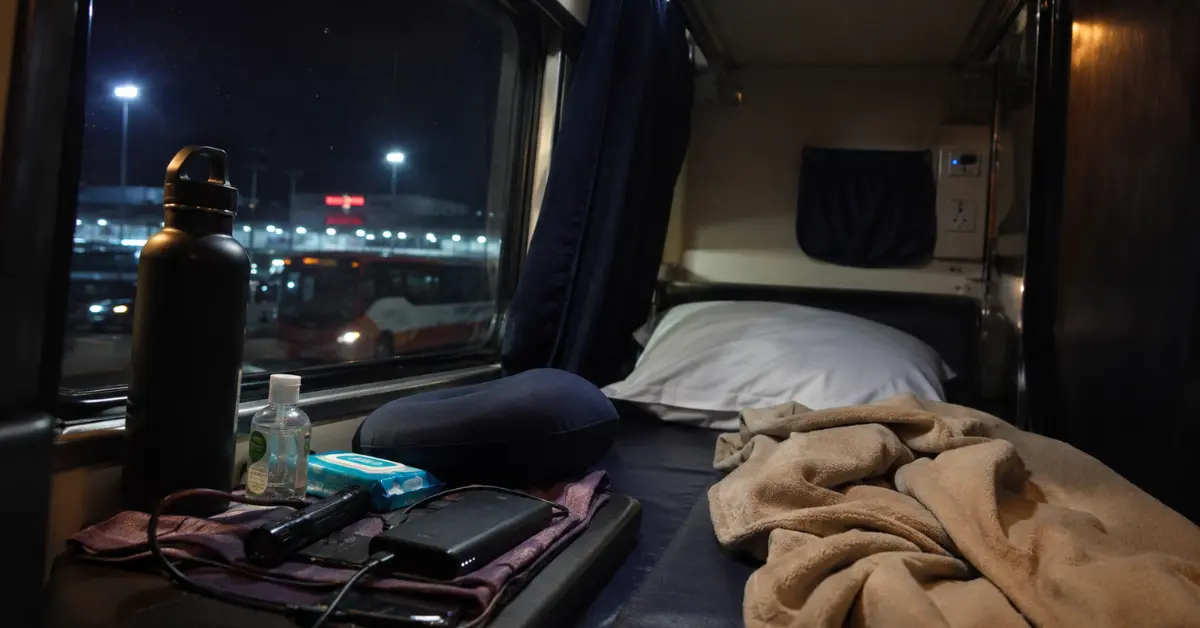
The core night bus travel essentials in India are a neck pillow, eye mask, earplugs, a power bank, a light blanket or shawl, hand sanitizer and wet wipes, a water bottle, motion sickness tablets, and your ID kept on your person rather than in checked luggage.
What actually determines whether you arrive rested or wrecked, though, is how you organize these items between your cabin bag and your hold luggage, and how well you match your packing to the specific type of bus you have booked.
Most guides stop at the item list. That’s the easy 20% of the problem. The harder part, the part that actually changes your night, is sequencing and decision-making: what to keep on your body, what goes in your lap bag, what bus layout to book, and what to do when something goes wrong at 2 AM on a highway outside Nashik. That’s what this guide covers.
The Two-Bag Rule That Changes Everything
Here’s the mistake almost every first-timer makes: they pack one bag for the whole trip and shove it under the bus. Then at 11 PM they realize the charger, the eye mask, and the paracetamol are all buried under someone else’s suitcase in the luggage hold.
Split your packing into two bags before you even start listing items.
- Bag one, your cabin bag, stays with you on the seat or berth. It carries anything you might need between boarding and stepping off.
- Bag two, your hold bag, goes under the bus. It only carries things you won’t touch until you reach your destination.
The test is simple: if you can imagine needing it at 2 AM, it goes in the cabin bag. If it can wait until you’re checking into a hotel or reaching a relative’s house, it goes in the hold.
This single habit solves 80% of the “I forgot something important” problem that ruins most first overnight bus trips.
What Goes In Your Cabin Bag
Your cabin bag should fit under the seat in front of you or in your lap. Anything bigger and you’ll be fighting for space with your neighbour for ten hours.
Sleep kit:
- Neck pillow or inflatable travel pillow
- Eye mask
- Foam earplugs or noise-isolating earbuds
- A light shawl or thin blanket
Hygiene pouch:
- Hand sanitizer
- Wet wipes
- Tissues
- Toothbrush and a small tube of paste
- Lip balm (AC air dries your lips out fast on a 10-hour ride)
Electronics:
- Phone
- Power bank, charged the night before
- Charging cable kept in an outer pocket, not buried
Food and water:
- One litre of water minimum
- Dry snacks: nuts, biscuits, a banana or two
Documents and health:
- ID, kept on your person, not in the hold bag
- Printed or screenshotted ticket
- Motion sickness tablets, paracetamol, an ORS sachet
Bus Travel Blanket and Pillow Essentials
A lot of people assume the operator’s blanket will be enough. On budget and mid-range buses, it usually isn’t. It’s thin, it’s been used by dozens of passengers before you, and on AC sleeper coaches the temperature can drop hard after midnight.
Carry your own. A compact shawl or a thin fleece blanket that rolls up to the size of a water bottle does the job without eating your bag space. If you’re on a flat berth rather than a seat, a full-length blanket matters more than a neck pillow, since you have a flat surface and no need to support your head sideways.
Power Bank for Long Travel in India
This is the one item people underestimate until they’re stuck with a dead phone on a highway with no signal anyway.
Go for at least 10,000 mAh. That gives you roughly two full charges on an average smartphone. Even buses that advertise charging ports at every seat have ports that go loose or simply stop working, especially on older fleets and state RTC buses. Treat the onboard port as a bonus, not a plan.
One habit that saves a lot of grief: charge everything to 100% before you leave your house, not at the boarding point. Boarding areas are chaotic and you won’t remember to plug in.
What to Wear in AC Sleeper Bus
Dress in layers, not one thick jacket. You’ll go from a warm boarding hall to a cold AC cabin to a chilly 4 AM halt to a warm morning arrival, sometimes all within eight hours.
- Full-sleeve top or T-shirt with a light jacket over it
- Loose, breathable trousers, not jeans (jeans get uncomfortable fast on a reclined seat)
- Socks, always, even in summer, since cold feet are one of the most common reasons people wake up at 3 AM
- Slip-on shoes or sandals so you’re not bending into the aisle to tie laces during a rest stop
Packing Differs By Bus Type
This is where most guides get lazy. They write advice as if every night bus in India is a private AC sleeper with charging ports and curtains. It isn’t. Millions of people travel on non-AC state transport buses every night, and the packing priorities shift noticeably.
| Bus Type | What Changes | Priority Items |
|---|---|---|
| AC Sleeper (private, 2+1 layout) | Cold cabin, curtained berth, usually has charging | Light blanket, eye mask (curtains rarely block light fully), power bank as backup |
| AC Semi-Sleeper / Volvo type | Reclines but doesn’t go flat | Neck pillow is essential here, more than on a full sleeper |
| Non-AC Sleeper / State RTC | No climate control, windows may be open, mosquitoes | Full-length blanket in winter, mosquito repellent, own drinking water since halts are less predictable |
| Seater (any type, overnight route) | Upright posture for hours | Neck pillow, lumbar support if you have back issues, avoid this for routes over 8 hours if you can |
If you’re booking a non-AC RTC bus in winter on a north or hill route, treat it closer to a camping trip than a hotel-on-wheels. Carry a proper blanket, not just a shawl, and keep a torch or your phone’s flashlight handy since these buses rarely have working reading lights.
Sleeper Berth Booking Tips That Actually Affect Your Sleep
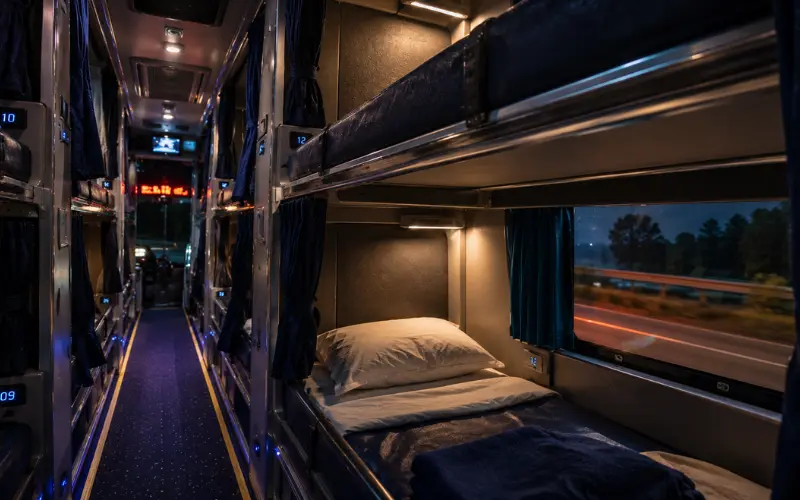
Where you sit matters more than what you pack. I’ve seen people carry a full sleep kit and still wake up every twenty minutes because they booked a rear upper berth on a bad road.
Middle of the bus, not front or back
The rear bounces hardest on uneven highways. The front catches engine noise and oncoming headlight glare through the windshield gap.
Lower berth over upper, if you have the choice
Less vibration, easier to get in and out of during rest stops without disturbing anyone.
Single-side berths on a 2+1 layout
give you the most width and the most privacy, since you’re not sharing the space with a stranger.
Book at least three to four days ahead for weekend travel
Friday and Sunday night departures fill up fast, and late bookings usually leave you with whatever’s left, which tends to be rear upper berths.
If your route runs through ghat sections or hill roads (Bangalore to Goa, Delhi to Manali, anything into the Western Ghats), the berth choice matters even more, since those roads have constant curves that amplify vibration toward the back of the bus.
Sleeper Bus Safety Tips for Solo Travelers
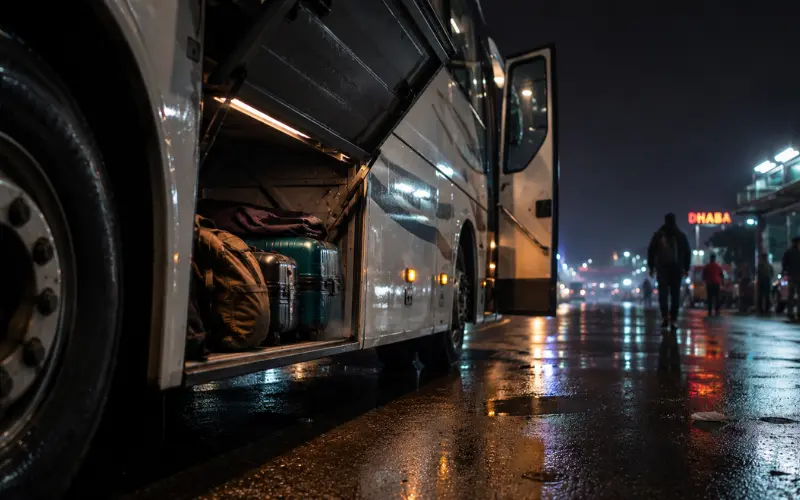
Solo night travel in India is common and, on a reputable operator, generally safe. But “generally safe” doesn’t mean skip the basics.
- Check the operator’s safety features before booking, not after. Look for GPS tracking, a helpline number listed on the ticket, and driver verification. Most decent apps show this at booking, not buried in terms and conditions.
- Share your live location with one person before you board and again after the rest stop. It takes ten seconds and it’s the single most useful habit for solo travelers.
- Keep your phone charged above 50% at all times during the trip, not just before boarding. A dead phone during an emergency is a genuinely bad position to be in.
- Trust discomfort over politeness. If a seat assignment, a fellow passenger, or a boarding point feels off, say something to staff immediately rather than deciding to just tolerate it for a few hours.
- Sit near the front or near other women/families if you’re a woman traveling alone, where that option exists on the seating chart. Many booking apps now let you see gender of nearby passengers before confirming.
For women traveling overnight specifically
Beyond the general safety points above, a few things worth carrying that most checklists skip entirely: a small scarf that doubles as a privacy cover when reclining, sanitary products regardless of trip length since delays happen, and a whistle or personal alarm clipped somewhere accessible, not buried in a bag. None of this is about assuming the worst. It’s about not having to improvise at 1 AM if something does come up.
How to Keep Luggage Safe in Sleeper Bus
Theft on Indian night buses is not common on reputable operators, but it’s not zero either, especially at crowded rest stops where dozens of buses halt at once.
- Never put your phone, wallet, or ID in the overhead net or seat pocket while you sleep. Keep them in a closed pocket on your body or under your pillow.
- Use a small cable lock or padlock on your cabin bag’s zipper if it’s the kind that faces the aisle or the window ledge overnight. It won’t stop a determined thief, but it stops the fifteen-second opportunistic grab.
- For your hold luggage, watch it get loaded and, if the operator allows it, ask for a numbered tag. Some seasoned travelers still swear by an old-school trick: a short chain and combination lock looped through the hold bag’s handle and a fixed part of the luggage compartment, so the bag physically can’t walk off during a stop.
- Keep a mental note (or a phone photo) of your bag’s exact position in the hold. It sounds excessive until you’re one of forty identical black suitcases at a 5 AM drop point.
Motion Sickness Tips During Bus Travel
Ghat roads, sudden braking, and reading your phone in a moving vehicle are the three biggest triggers for motion sickness on Indian night buses.
- Take your tablet 30 minutes before departure, not after you start feeling queasy. Once nausea sets in, the tablet works far slower.
- Book a seat over the rear axle or ahead of it, not directly at the back. Motion is amplified the further back you sit.
- Avoid reading or scrolling your phone for the first hour, especially on winding sections. Looking at a fixed point outside, or just closing your eyes, settles your inner ear faster than a screen will.
- Eat light two to three hours before boarding. A heavy, oily meal right before a bumpy ride is close to a guaranteed bad night.
- Ginger candy or ginger tea at the rest stop works as a mild natural top-up if you don’t want to rely on tablets alone.
If you know a co-passenger is struggling and you happen to be carrying a spare tablet, offering it is one of those small gestures that regular overnight travelers do for each other. It costs you nothing and it’s often remembered.
Seasonal Packing Adjustments
Nobody’s packing list should look the same in June as it does in December, but most competitor guides write one generic list for the whole year.
- Monsoon routes (June to September): carry a waterproof cover for your hold bag, since luggage compartments aren’t always fully sealed. A compact umbrella or poncho in your cabin bag helps at rest stops where the halt area often has no shelter.
- Winter Himalayan and hill routes (Manali, Kashmir, Uttarakhand, Darjeeling-bound connections): a shawl is not enough. Carry a proper full-length blanket or a thin sleeping bag liner, thermal socks, and consider carrying your own bottled water since taps at high-altitude halts can run freezing cold or simply not work.
- Summer plains routes (Rajasthan, central India, Deccan interiors): carry more water than you think you need, an electrolyte or ORS sachet is genuinely useful here, and avoid heavy meals before boarding since dehydration and heat make digestion sluggish.
What NOT to Pack
Knowing what to leave behind saves as much stress as knowing what to carry.
- Strong-smelling food. Biryani, fried snacks, anything pungent, in a closed cabin, is inconsiderate to everyone around you and often against operator rules anyway.
- Glass bottles or containers. Bus movement makes spills likely and glass is a genuine hazard in a moving vehicle.
- Multiple outfit changes. One fresh set for arrival is enough. Extra clothes just take up bag space you’ll want for your sleep kit.
- Thick hardcover books. A phone with downloaded content, or a lightweight e-reader, does the same job for a fraction of the weight.
- Loose cash in an overhead bag. Keep travel money on your person, split between two pockets if you’re carrying a meaningful amount.
- Heavy laptops in your lap bag. Pack them in padded protection in the hold instead of having them bounce on the seat beside you all night.
When Things Go Wrong: A Quick Troubleshooting Guide
Preparation covers most nights. Some nights still go sideways. Here’s what actually helps when they do.
You missed your stop because you fell asleep.
Don’t panic and don’t get off at a random point in the dark. Call the operator’s helpline, explain your situation, and ask for the nearest safe drop point or the next available stop. Most GPS-tracked operators can locate the bus and guide you.
Your phone died and you have no power bank.
Ask the conductor or driver if the bus has a functioning charging point near the driver’s cabin, many do even if seat-level ports are down. If not, borrow a charger cable from a fellow passenger, most people carry a spare.
You feel genuinely unwell mid-journey.
Tell the conductor immediately rather than waiting it out. Buses do make unscheduled stops for medical situations, and it’s far better to speak up early than to wait until the next scheduled halt.
The bus is delayed by hours.
Message whoever is picking you up as soon as you get a rough new ETA rather than waiting for exact certainty. Build a buffer into your onward plans whenever you can, especially if you have a connecting flight or train the same morning.
You realize you packed your ID in the hold bag by mistake.
Some highway checkpoints, particularly near state borders, do ask for ID from bus passengers. If yours is in the hold, tell the conductor before the checkpoint rather than during it, so there’s time to sort it out calmly.
The Reusable Night Bus Kit
If you take overnight buses more than once or twice a year, stop repacking from scratch every time.
Set aside a small pouch or drawstring bag and keep your sleep kit, hygiene items, and a spare charging cable in it permanently. Restock the consumables (wipes, sanitizer, snacks) after each trip and leave the durable items (pillow, eye mask, earplugs, power bank) inside at all times.
The next time you book a ticket, your packing time drops from twenty minutes of hunting through drawers to grabbing one pouch off a shelf. It sounds like a small thing. After the third or fourth trip, it’s the difference between packing being a chore and packing being a non-event.
Quick Reference: Cabin Bag vs Hold Bag
| Goes in Cabin Bag | Goes in Hold Bag |
|---|---|
| ID, ticket, phone, wallet | Extra clothes for after arrival |
| Power bank, charging cable | Heavy or bulky items |
| Neck pillow, eye mask, earplugs | Laptop (padded, not in lap bag) |
| Water, snacks, medicines | Toiletries you won’t need mid-journey |
| Blanket or shawl | Gifts, shopping, non-urgent items |
Frequently Asked Questions
Is it safe to sleep during an overnight bus journey in India?
Yes, on reputable, GPS-tracked operators with verified drivers. Keep your phone charged, your valuables on your body rather than in overhead storage, and share your live location with someone before you doze off.
What is the best berth to book on a sleeper bus for a smoother ride?
A lower berth in the middle section of the bus, ideally on the single side of a 2+1 layout. It has the least vibration and the most privacy of any seating position.
Do I need to carry my own blanket if the bus provides one?
On most private AC sleeper buses, yes. The provided blanket is often thin and shared across many trips. Non-AC and RTC buses may not provide one at all, especially on older fleets.
How early should I take a motion sickness tablet before an overnight bus trip?
About 30 minutes before departure. Waiting until you already feel nauseous makes the tablet work slower and less effectively.
What should solo women travelers specifically check before booking a night bus?
Operator safety features like GPS tracking and a working helpline, seat assignment near other women or families if the app allows it, and reviews focused specifically on solo female passenger experiences rather than general ratings.
Can I charge my phone throughout the night on an Indian sleeper bus?
Many modern AC sleeper buses have a charging port per berth, but ports do fail or loosen over time. Carry a power bank rated at least 10,000 mAh as your primary backup rather than relying on the port.
What’s the biggest packing mistake first-time overnight bus travelers make?
Packing one single bag and putting it all in the hold. Anything you might need during the ride, like your charger, ID, or medicine, ends up buried under the bus instead of within reach.
Is a non-AC sleeper bus a bad idea for a long overnight route?
Not necessarily, especially for budget travel or winter routes, but you’ll need to pack differently: a proper full-length blanket instead of a light shawl, mosquito protection, and your own water since rest stops on these routes are less predictable than on premium services.
