

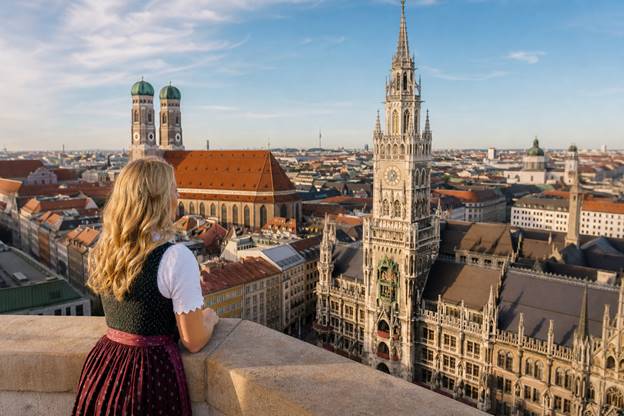
Most travellers arrive in Bavaria with a rough mental map: Munich, beer tents, maybe a day trip to Neuschwanstein. That is a fine start, but it barely scratches what the region offers. A well-structured Bavaria travel itinerary for 2026 uses Munich as a convenient entry and exit point, then fans out in two or three directions to combine genuinely contrasting experiences: alpine scenery south of the city, fairy-tale castles to the southwest, and historic Franconian towns to the north.
Munich earns its hub status honestly. It has one of Germany’s busiest international airports, a dense rail network that reaches most of Bavaria without a car, and enough within its own boundaries to fill two or three days comfortably. The Altstadt, the Englischer Garten, Nymphenburg Palace, and the Deutsches Museum alone could absorb a full weekend. But the real logic of the hub model is efficiency: you check in to Munich on day one, travel outwards to the Alps or the Romantic Road towns, and return to fly home without back-tracking or juggling multiple car-hire locations.
This guide will help you choose the right trip length, pick the smartest months to visit in 2026, and build a day-by-day structure around a set of contrasting destinations that goes well beyond the beer tents.
Munich Beyond Oktoberfest: How to Plan the Ultimate Bavaria Travel Itinerary in 2026
When to visit Bavaria in 2026 and how Oktoberfest still affects your plans
The most important 2026-specific factor to understand is Oktoberfest, even if you have no intention of attending. Oktoberfest Munich is the crown jewel of Bavaria’s festival scene, and the festival typically runs from late September into the first weekend of October; confirm exact 2026 dates via official Munich sources before booking. During those roughly two and a half weeks, Munich hotel prices spike sharply, many properties impose minimum stays of three to five nights, and trains into the city fill up fast. That pricing pressure radiates outward too, because accommodation near Füssen, the Bavarian lakes, and Romantic Road towns all trends higher during this window as day-trippers and overflow guests spread across the region.
Core stops beyond Munich: castles, Alps, lakes and smaller towns to mix and match
Think of Bavaria’s best destinations in three geographic bands, each within reach of Munich but distinct in character. Choosing one or two stops from each band produces a trip with genuine variety rather than a blur of similar sights.
The southern Alps band offers two main bases. Garmisch-Partenkirchen sits roughly 1.5 hours from Munich by regional train and pairs a classic mountain-town feel with easy access to the Zugspitze, Germany’s highest peak, via cable car. It suits walkers, photographers, and anyone who wants alpine scenery without long drives on narrow roads. Berchtesgaden, about 2.5 hours from Munich by train and bus, is quieter and more dramatic: the Königssee is widely considered one of Germany’s most stunning alpine lakes, and the surrounding peaks feel genuinely remote. Staying overnight here rather than visiting on a day trip means you can catch the lake in morning light before the crowds arrive.
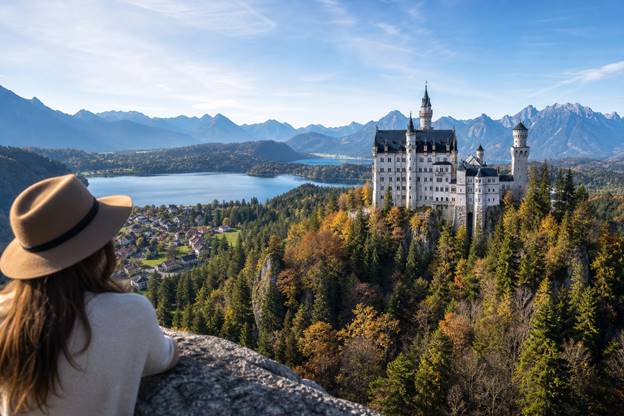
The castle stretch around Füssen takes roughly 2 hours from Munich by direct train. Neuschwanstein and the adjacent Hohenschwangau are the main draws, but both require advance timed tickets, particularly in summer; arriving without a booking almost guarantees a long wait or a turned-away disappointment. Staying one night near Füssen transforms this from a rushed day trip into a proper visit, with time for the surrounding village and easier access to morning slots. For lakes that work as overnight bases or slower-paced additions, Tegernsee is reachable in under an hour from Munich and offers boat trips, lakeside walks, and a relaxed local atmosphere.
The Franconian band to the north is where culture-seekers find most of their time well spent. Nuremberg is about 1 hour from Munich by fast train, large enough to feel like a real city, and carries significant Second World War history alongside a lived-in old town. Regensburg, also around 1.5 hours by train, has one of Bavaria’s finest riverfront old towns and a strong local food scene. Bamberg, slightly further, is often cited as one of Germany’s most underrated cities, with a UNESCO-listed centre and a brewing tradition that predates Oktoberfest by centuries. Rothenburg ob der Tauber is the most photogenic of the Romantic Road towns and genuinely impressive, but it draws large coach-tour crowds; a morning arrival helps, and it is most easily reached via Ansbach by rail.
A well-balanced Bavaria route includes at least one vibrant city day, one or two castle or old-town days, and two or more nature-heavy days. Trying to tick every name on this list in five days produces a trip of transit rather than experience.
Sample Bavaria travel itinerary 2026: realistic 5-, 7- and 10-day routes
All three suggested routes assume you fly into and out of Munich. The 5- and 7-day versions are manageable largely by public transport; the 10-day version benefits from a hire car for at least part of the journey, particularly the alpine and lake sections.
5-day taster (best for first-timers or short annual leave):
Days 1–2: Munich. Arrive and orient yourself in the Altstadt; spend the second day covering Nymphenburg Palace or the Deutsches Museum and an afternoon in the Englischer Garten. Day 3: Travel to Füssen (roughly 2 hours by train), check in, and visit Neuschwanstein and Hohenschwangau with pre-booked timed tickets. Days 4–5: Move to Garmisch-Partenkirchen (about 45 minutes from Füssen by bus or car) for alpine walks and the Zugspitze cable car, then return to Munich on the morning of day 5 in time for a flight or an extra evening in the city. Keep one half-day unscheduled as a buffer for weather or delays.
7-day balanced route (city, castles, Alps, and one Franconian city):
Days 1–2: Munich. Day 3: Train to Füssen for the castles. Days 4–5: Berchtesgaden or Garmisch-Partenkirchen for alpine scenery and the Königssee or Zugspitze. Days 6–7: Train to Nuremberg (from Garmisch allow around 3 hours via Munich; from Berchtesgaden around 3.5 hours), with time to walk the old town and visit the castle or documentation centre before returning to Munich on day 7. The Munich–Nuremberg direct train takes roughly 1 hour and runs frequently.
Alternative 7-day route for culture-focused travellers:
Days 1–2: Munich. Days 3–4: Nuremberg and Bamberg (30 minutes apart by train). Day 5: Regensburg or Rothenburg ob der Tauber. Days 6–7: Return south for one alpine base — Garmisch or a single night at Tegernsee — before flying home from Munich. This version trims mountain time but gives a far fuller picture of Franconian history and architecture.
10-day deeper Bavaria trip:
Days 1–3: Munich, including a half-day at Lake Starnberg or Tegernsee (both under an hour by train) as a gentle introduction to the Bavarian lake district. Days 4–5: Füssen, with a full day for the castles and a second for easier walks in the surrounding area. Days 6–8: Berchtesgaden for the Königssee, alpine trails, and a second excursion to nearby villages. Days 9–10: Nuremberg and either Bamberg or Regensburg before returning to Munich. With 10 days you can afford to move every two nights rather than one, which makes the whole journey feel considerably more restful.
Think of these as skeletons rather than scripts. Swapping Nuremberg for Regensburg, or Garmisch for Berchtesgaden, changes the character of the trip without breaking its logic.
Sample Bavaria travel itinerary 2026: realistic 5-, 7- and 10-day routes
Getting around efficiently: Munich hub, public transport vs car, and avoiding back-tracking
Munich works as a hub because of its rail connections as much as its airport. From Munich Hauptbahnhof you can reach Nuremberg in about 1 hour by ICE, Garmisch-Partenkirchen in roughly 1.5 hours by regional train, Füssen in around 2 hours by direct train, and Berchtesgaden in approximately 2.5 hours with one change. Regensburg takes about 1.5 hours by direct train. Those journey times mean most major stops are feasible as overnights without sacrificing an unreasonable amount of each day to transit.
The honest comparison between public transport and a hire car comes down to the shape of your itinerary. If your route focuses on Munich plus the main hubs — Nuremberg, Regensburg, Garmisch, Berchtesgaden, or a Salzburg extension — trains are fast, affordable when booked early, and remove the stress of alpine driving and city parking. If you want to link smaller lake villages, explore rural viewpoints, or move between several Romantic Road towns in one day, a car gives flexibility that no rail pass can match, and it becomes genuinely cost-efficient for groups of three or four.
A practical approach: book trains for any city-to-city leg where the service is direct and frequent, then consider a car for the alpine or lake section only, picking it up in Füssen or Garmisch rather than in Munich city centre. This avoids environmental zone complications and expensive central parking. Munich’s city centre requires an environmental zone sticker and charges significant parking fees, so returning a hire car before your final Munich nights saves both money and hassle.
To avoid back-tracking, sketch your stops as a rough arc on a map before booking anything. A southward loop — Munich, Franconia (Nuremberg or Regensburg), then south through Rothenburg, west to Füssen, east to Berchtesgaden, and back to Munich — covers the main regions without retracing the same road. Alternatively, head south first for the Alps and loop north through Franconia before ending in Munich. Either arc works; what does not work well is multiple out-and-back day trips from Munich alone, which wastes time and money on repeated long journeys.
For ticketing in 2026: buy long-distance ICE and IC rail tickets as early as possible for the best advance fares, but use flexible regional tickets or Bayern-Ticket-style day passes for shorter mountain hops, so that weather-sensitive excursions can shift a day without penalty.
Tailor your 2026 Bavaria itinerary to your style – and add Salzburg without overdoing it
The sample routes above have natural adjustment points depending on what you actually want from the trip.
Culture-seekers should add time in Munich’s museum quarter — the Alte Pinakothek alone is worth half a day, and it is currently hosting Neue Pinakothek works while that building undergoes renovation expected until 2029 — extend Nuremberg to two nights, or add Bamberg as a second Franconian stop. The trade-off is trimming one lake or hiking day, which is a straightforward swap if mountains are not the draw.
Hikers and photographers get the most out of anchoring two or three nights in Berchtesgaden or Garmisch-Partenkirchen rather than splitting time between both. Early starts matter in the Alps: the Königssee before 9am is a genuinely different experience from midday. If sunrise and sunset shots are a priority, plan your hotel location accordingly and keep the city days to a minimum so the pace stays relaxed enough to be up at dawn.
Families benefit most from fewer hotel changes. Two-night stays — Munich, one alpine base, one Franconian or Romantic Road town — reduce the logistics of packing and unpacking with children. Lake boat trips, the walks around Füssen, and fortress visits tend to work better with young travellers than full museum days. The castles around Füssen are genuinely exciting for children, provided the timed ticket is booked well in advance.
Adding Salzburg is straightforward if you are already planning time in Berchtesgaden, since the Austrian city is less than an hour away by bus. A 7-day trip can include 1–2 nights in Salzburg if it replaces one alpine base rather than being added on top of everything else; a 10-day trip handles 2–3 nights in Salzburg comfortably. The mistake most people make is treating Salzburg as a free extra rather than a deliberate trade-off. Squeezing in Austria, another German region, and every Bavarian town on the list turns a scenic loop into a series of rushed one-night stays where nothing gets the time it deserves.
The most useful next step is a concrete one: pick your preferred month, choose one of the three sample itineraries as a base, and sketch the overnight stops on a map to check for back-tracking. Then book Munich and your key hotspots — Füssen, Berchtesgaden or Garmisch, and whichever Franconian city appeals — before filling in the smaller details. A great Bavaria trip in 2026 is not about volume; it is about choosing a small number of genuinely contrasting places and giving each one enough time to actually leave an impression.
